
Відомості про публікацію
- Автор
- Дата публікації
- 08.01.2022
- Тип публікації
- Науковий / технічний матеріал
- Установа
- Запорізький національний університет
Повний текст
Abstract
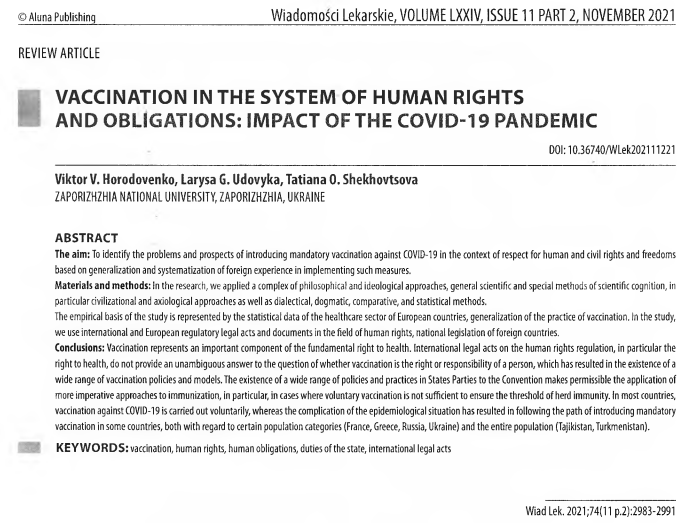
©Aluna Publishing Wiadomosci Lekarskie, VOLUME LXX1V, ISSUE 11 PART 2, NOVEMBER 2021
REVIEW ARTICLE
VACCINATION IN THE SYSTEM OF HUMAN RIGHTS
AND OBLIGATIONS: IMPACT OF THE COVID-19 PANDEMIC
DOI: 10.36740/WLek202111221 Viktor V. Horodovenko, Larysa G. Udovyka, Tatiana 0. Shekhovtsova
ZAPORIZHZHIA NATIONAL UNIVERSITY, ZAPORIZHZHIA, UKRAINE
The aim: To identify the problems and prospects of introducing mandatory vaccination against COVID-19 in the context of respect for human and civil rights and freedoms based on generalization and systematization of foreign experience in implementing such measures.
Materials and methods: In the research, we applied a complex of philosophical and ideological approaches, general scientific and special methods of scientific cognition, in particular civilizational and axiological approaches as well as dialectical, dogmatic, comparative, and statistical methods.
The empirical basis of the study is represented by the statistical data of the healthcare sector of European countries, generalization of the practice of vaccination. In the study, we use international and European regulatory legal acts and documents in the field of human rights, national legislation of foreign countries.
Conclusions: Vaccination represents an important component of the fundamental right to health. International legal acts on the human rights regulation, in particular the
right to health, do not provide an unambiguous answer to the question of whether vaccination is the right or responsibility of a person, which has resulted in the existence of a wide range of vaccination policies and models. The existence of a wide range of policies and practices in States Parties to the Convention makes permissible the application of more imperative approaches to immunization, in particular, in cases where voluntary vaccination is not sufficient to ensure the threshold of herd immunity. In most countries, vaccination against COVID-19 is carried out voluntarily, whereas the complication of the epidemiological situation has resulted in following the path of introducing mandatory
vaccination in some countries, both with regard to certain population categories (France, Greece, Russia, Ukraine) and the entire population (Tajikistan, Turkmenistan).
KEYWORDS: vaccination, human rights, human obligations, duties of the state, international legal acts
WiadLek. 2021,74(11 p.2):2983-2991
INTRODUCTION
One of the greatest challenges of our time, which has reached a global scale, is the pandemic of the coronavirus infection COVID-19. Having originated in the Hubei Province of China in early January 2020, the epidemic very quickly spread outside China and penetrated into almost all countries of the world. On March 11, 2020, taking into account the pace and scale of the virus spread, the World Health Organization declared COVID-19 a pandemic.
As of September 30, 2021, over 233 million cases of COVID-19 had been detected worldwide, with nearly 5 million of them being lethal. The largest number of cases of virus infection occurred in North and South America jointly (nearly 90 million cases). High morbidity rates are also observed on the European subcontinent (over 70 million cases). A more favorable epidemiological situation has developed in the countries of Southeast Asia (nearly 43 million in total), which can be characterized by a rapid response to the first outbreaks of infection and the intro duction of strict anti-epidemic measures, including state coercion [1], The sudden appearance of the Corona Virus can be considered by some to be a “black swan” event, because
it makes a devastating appearance and influence on all aspects of globalization and international relations [2], Today, it is obvious that the pandemic is a global chal lenge that almost in no time changed the socio-economic, political, geopolitical, and humanitarian situation in the world and caused a systemic crisis in most spheres of public life, the way out of which can be difficult and protracted.
The major geopolitical turn is being observed in the economy, which is experiencing the largest collapse since the Great Depression. The experts and analysts of the In ternational Monetary Fund have repeatedly stressed that the economic crisis caused by the pandemic will result in a significant decline, greater than that experienced during the global economic crisis in 2008. Among the political consequences, we should highlight, in particular, the spread of authoritarianism, increased state supervision, control, repressive measures, ethnic nationalism under the slogans of fighting against the pandemic, curtailing public freedoms, which in turn have resulted in a drop in the level of trust in governments and state institutions [3].
The COVID-19 pandemic has also had a devastating impact on the healthcare system, which proved unable to withstand an epidemic crisis of such a scale. The rapid spread of the disease and limited actual data on the virus resulted in the situation when national health systems were on the verge of collapse. Moreover, this situation turned out to be typical not only for developing countries but
also for the countries with a traditionally high standard of living, which are considered developed. For example, according to M. Kendrick, a doctor of the National Health Service, the British healthcare system has contributed to deepening the crisis by giving chaotic, often directly oppo site instructions. One of these guidelines was the decision to place elderly people, including those with COVID-19 symptoms, in nursing homes, which led to the surge in the disease incidence at these institutions.
In the United States, the treatment of complex diseases, in particular, COVID-19, is too expensive and is not covered by basic health insurance, which resulted in the fact that access to healthcare services is not actually guaranteed to everyone [4].
In the context of the pandemic, the governments were forced to make serious legislative and managerial decisions within the shortest time possible, taking into account the epidemiological situation, which was constantly changing.
The main focus has been placed on ensuring the proper functioning of the healthcare systems under crisis condi tions, with the core issues being the search for effective measures to prevent the virus spread, minimization of the increase in morbidity, fast identification, and isolation of the people infected and providing them with qualified medical care [5]. One of the major consequences of the cur rent public health crisis has been the resumption of debate about the need to introduce mandatory vaccination, which, according to WHO experts, is currently the only effective means of countering and overcoming the pandemic.
“Despite the fact that vaccination is a widespread pre ventive medical intervention, there is a scientific consensus that a number of vaccines might produce serious injuries to some people, and that these two facts create evident competing interests for any Government between public health, individual rights, and even the economic interests of some actors” [6]. Given the fact that each state has been developing and implementing its own strategy for overcoming the crisis caused by the pandemic with consideration of the epidemiological situation, peculiarities of mentality, public and legal life, the issue of vaccination against COVID-19 is marked by the polarity of views from incorporating the mandatory nature of such medical
intervention into the legislation to implementing it on a voluntary basis.
THE AIM
To identify the problems and prospects of introducing mandatory vaccination against COVID-19 in the context of respect for human and civil rights and freedoms based on generalization and systematization of foreign experience in implementing such measures.
MATERIALS AND METHODS
In the research, we applied a complex of philosophical and ideological approaches, general scientific and special methods and means of scientific cognition, in particular civilizational and axiological approaches as well as dialec tical, dogmatic, comparative, and statistical methods. The determinants of the research process were civilizational and axiological approaches used to justify the importance of human rights, their universality, and particularity; a dialectical method applied to identify the relationship between international, European, and national legislation in the field of human rights; a comparative legal approach used to analyze foreign experience in implementing the vaccination measures in the context of ensuring respect
for human rights and freedoms, as well as systematization, analysis, and synthesis. The empirical basis of the study is represented by the statistical data of the WHO and healthcare sectors of European countries, generalization of the vaccination practice. In the study, we use international and European regulatory legal acts and documents in the field of human rights, national legislation of foreign countries, namely the Universal Declaration of Human Rights, the International Covenant on Economic, Social and Cultural Rights, the CESCR General Comment No. 14: the Right to the Highest Attainable Standard of Health, the 1947 Nuremberg Code, the Convention for the Protection of Human Rights and
Dignity of the Human Being with regard to the Application of Biology and Medicine, the Convention on Human Rights and Biomedicine, the Universal Declaration on Bioethics and Human Rights.
REVIEW AND DISCUSSION
The fundamental international document, which was the first to proclaim and enshrine the right to health protection, is the Universal Declaration of Human Rights adopted in 1948. According to Article 25, “Everyone has the right to a standard of living adequate for the health and well-be ing of himself and of his family, including food, clothing, housing, and medical care and necessary social services...”
[7], Despite the fact that the given Act only provides a gen eralized definition of the relevant right, it was an important step for this right to be further constituted and recognized internationally. As an independent fundamental right, health was first defined in the WHO Constitution of 1946, where the preamble says: “The enjoyment of the highest attainable standard of health is one of the fundamental rights of every human being without distinction of race, religion, political belief, economic or social condition” [8], Moreover, the Constitution provides a broad interpretation of the con cept of‘health’, which is understood not only as merely the absence of disease or physical disabilities but as a state of
complete physical, mental and social well-being. The content of the right to health is described in more detail in the International Covenant on Economic, Social, and Cultural Rights of 1966, which is a generally recognized core mechanism for protecting this right. Article 12.1 of the Covenant says that the States Parties to the present Covenant recognize the right of everyone to the enjoyment of the highest attainable standard of physical and mental
health. The measures necessary to ensure the realization of this right are provided for by Article 12.2 and include those necessary for 1) the provision for the reduction of the stillbirth rate and of infant mortality and for the healthy development of the child; 2) the improvement of all aspects of environmental and industrial hygiene; 3) the prevention, treatment, and control of epidemic, endemic, occupational and other diseases; 4) the creation of conditions which would assure to all medical service and medical attention in the event of sickness [9], In the context of studying the place of vaccination in the system of human rights and responsibilities, para 3, which directly concerns ensuring
the implementation and legal guarantees for the protection of human health in epidemiological emergency situations, is of particular importance. In the General Comment No. 14: the Right to the High est Attainable Standard of Health, adopted on 11 August 2000, the UN Committee on Economic, Social and Cul tural Rights interprets the relevant provision, according to which, inter alia, the control of diseases refers to the implementation or enhancement of immunization pro grams and other strategies of infectious disease control [10]. The Commission also notes that such immunization programs are implemented in relation to major infectious diseases, and their development and implementation is a state responsibility of comparable priority.
This position is generally reproduced in the European acts meant to regulate human rights. Thus, in the Statement on the Right to Protection of Health in Times of Pandemic, the European Committee of Social Rights emphasizes that the operation of widely accessible immunization programs is provided for in para 3 of Article 11 of the 1961 Euro pean Charter of Social Rights, under which the states are obliged to maintain high coverage rates not only to reduce the incidence of relevant diseases but also to neutralize the reservoir of virus and thus achieve the goals set by the WHO to eradicate a range of infectious diseases [11], Thus, the international legal acts that directly or indi rectly concern the problem of vaccination do not provide
an unambiguous answer to the question of whether such medical intervention is a human right or obligation. Fur thermore, the uncertainty of legislative regulations results in the lack of a unified approach to the use of immunization in practice.
Moreover, the European regulatory framework does not regulate whether vaccines are mandatory or recommend ed, since the EU’s role in health policy is limited, and the Member States remain free in their decision. Thus, the National Health Services of most European countries have different vaccination systems, different vaccine recommen dations, and different schedules of vaccine administration.
For instance, 15 of the 27 European countries, namely, Austria, Cyprus, Denmark, Estonia, Finland, Germany, Ireland, Lithuania, Luxembourg, the Netherlands, Norway, Portugal, Spain, Sweden, and the United Kingdom have no obligation to vaccinate. The other countries have an obligation to vaccinate with between 1 vaccine (Belgium) and 12 (Latvia) [12], Generally, it is characteristic of most European countries to use a combined approach:
mostly, vaccination is recommended for the population, but for some of its categories belonging to risk groups, it is mandatory. A similar variety of approaches to vaccination is typical of other regions of the world. Thus, this situation is par ticularly pronounced in the Middle East. For example, in Pakistan, the National Expanding Program on Immuni zation provides for immunization of all children between 0 and 23 months against 8 vaccine-preventable diseases.
Despite this, routine immunization coverage in Pakistan is far from optimal. The country is one of 10 countries with at least 60% of children unvaccinated. Moreover, the country has about 33% of the children who must be immunized in accordance with WHO immunization targets for the Region [13]. It is significant that in this country there is a difference in vaccination coverage in terms of geography:
residents of urban communities have a higher level of immunization than provincial and, especially, rural ones, where local customs and beliefs are critical in solving the issue of vaccination as well as other medical interventions.
“The roots of this local resistance toward vaccination must be understood within overall geopolitical context. From this perspective, we can understand how vaccination may be perceived at the local level not as a life-saving en deavor but as a “political project” [14]. The COVID-19 pandemic has provided an unexpected incentive for further spread of this interpretation: the Pakistani population has long perceived the new infectious disease as a “western scenario” designed to ensure the political hegemony of the Western world and placement of other states in the depen dent position. This negative assessment served as another proof for the population of the general senselessness and even harmfulness of the vaccination.
The insufficient level of the population’s vaccination leads to the spread of epidemic diseases in the country, including those currently considered suppressed. “Pakistan is one of the two polio-endemic countries; the other is its neighboring Afghanistan. Both have collectively contrib uted 85% of recent polio cases globally” [14]. Measles and other diseases also prevail in the country. Under such circumstances, the Government of Pakistan is forced to implement supplementary vaccination measures against the most threatening epidemic diseases, but in the context of the pandemic and extreme contagiousness of the new virus, these programs have been mostly curtailed.
Tire diametrically opposite approach is applied by Oman, which is currently one of the most developed countries in the Arab East. The Sultanate’s immunization policy is based on the principle to immunize all children under one year old against the 12 vaccine-preventable childhood diseases (primary immunization and boosters). In Manual of Ex panded Program on Immunization it is especially empha sized that given the success of reduction in the incidence of the vaccine-preventable diseases in the Sultanate of Oman, and the consequent decline in levels of avoidable sickness, disability, and death, it is important that every opportunity should be taken to immunize the target population in order
to sustain the gains made so far [15], To achieve this goal, every contact of a child, mother, and female with the health delivery system is used. The vaccination exemption is only permitted if there are medical contraindications, with mild diseases not being the reason for the exemption.
Oman’s balanced public policy in the field of healthcare in general, and immunization in particular, has had positive consequences for ensuring public health and epidemiolog ical safety of the population. Thus, the Sultanate has been constantly demonstrating a high vaccination coverage level, which increased from 10% in 1985 to over 95% in 1995.
In 2019, the population vaccination rate reached 100% for all types of vaccines. Several vaccine-preventable diseases have either been eliminated or their numbers have reduced substantially. For instance, the country has maintained the polio-free status since 1994 as well as the zero incidence status of diphtheria since 1992 [16]. In 2016, the vaccine management system of Oman received an overall rating of 99% as part of the WHO Effective Vaccine Management Project, which was the best rate among the 90 countries that participated in the study.
The immunization system in China, which is one of the major countries in the Asia-Pacific region and one of the world’s largest vaccine manufacturers, has some special features. Vaccines in China are divided into two classes:
a) the first class - vaccines, provided for citizens by the government free of charge: citizens should get immunized according to the government’s regulations. Currently, the National Immunization Plan provides for immunization against 12 vaccine-preventable diseases. Also, this category includes supplemental vaccines paid for by lower-level governments, and emergency-use vaccines paid for by the government; b) the second class - other vaccines, provided at people’s own expense and on a voluntary basis. The divi sion of vaccines into classes is important for determining the nature of immunization. Thus, timely immunization with the first category vaccines is considered a societal duty, although not a mandate as there is no punishment associat
ed with the non-compliance [17]. As far as vaccines of the second category are concerned, they are not mandatory: people are vaccinated at their own request and expense. The original Chinese vaccination system demonstrates high efficiency in practice. The WHO states that China’s immunization program has dramatically reduced the number of vaccine-preventable diseases. For example, polio in this country had been eradicated by the year 2000; in 2021, China was also certified as a malaria-free country.
China has reached over 95% coverage for immunization [18]. Undoubtedly, this is also facilitated by the Chinese mentality traditionally characterized by a high level of trust and respect for the authorities as well as responsibility and strict implementation of government instructions, which was clearly demonstrated during the COVID-19 pandemic in this country.
In the context of the pandemic, the problem of searching for the optimal vaccination model has become particularly acute for national governments. High contagiousness of the SARS-CoV-2 virus, its resistance to the traditional treat ment methods, an increased risk of negative consequences after the recovery as well as the emergence of new virus strains being more drug-resistant and resulting in a more complex course of the disease, make immunization the only reliable way to overcome the pandemic. To achieve an optimal result, vaccination against COVID-19 should have a systematic and comprehensive character, which is not always achieved by means of “soft power”. Therefore, the need to ensure the balance between private (human
rights, in particular, to medical care and medical inter ventions as well as possible restrictions on them due to refusal of vaccination) and public interests (state security, epidemiological well-being, and public health) requires caution when using stricter measures to ensure an appro priate level of immunization.
This situation has resulted in the fact that the decision on the introduction of mandatory vaccination in most countries has not been made yet. National states generally consider vaccination as a type of medical intervention, with the main consequence being the obligation to guarantee the patients autonomy, including the requirement of voluntary informed consent, which is now the international standard for conducting medical research.
The first act that made mandatory the patient’s voluntary consent in medical practice was the Nuremberg Code of 1947, adopted after the completion of the Nuremberg trial of Nazi doctors, in which para 1 enunciates that when carrying out experiments on human subjects, the volun tary consent of the human subject is absolutely essential.
This means that the person involved should have the legal capacity to give consent; should be so situated as to be able to exercise free power of choice, without the intervention of any element of force, fraud, deceit, duress, overreaching, or another ulterior form of constraint or coercion; and should have sufficient knowledge and comprehension of the elements of the subject matter involved as to enable him to make an understanding and enlightened decision [19].
Despite the fact that this document is mainly aimed at reg ulating the conduct of medical experiments and research on people, the principles set out in it were fundamental for building the post-war system of health regulation and laid the basis for the majority of international legal acts on the regulation of medical practices.
Within the European legal framework, the main doc ument regulating the procedure for conducting medical research is the 1997 Convention for the Protection of Human Rights and Dignity of the Human Being with regard to the Application of Biology and Medicine (Ovie do Convention). Articles 5-6 of the given Act set out the requirements to be met when intervening in the field of human health, among them there are as follows: a) an intervention in the health field may only be carried out after the person concerned has given free and informed consent to it; b) this person shall beforehand be given appropriate information as to the purpose and nature of the intervention as well as on its consequences and risks; c)
an intervention may only be carried out on a person who does not have the capacity to consent, for his or her direct
benefit; d) where a minor does not have the capacity to consent to an intervention, or an adult, because of a mental disability, a disease or for similar reasons, the intervention may only be carried out with the authorization of his or her representative or an authority or a person or body provided for by law. Moreover, the individual concerned shall as far as possible take part in the authorization procedure, and the opinion of the minor shall be taken into consideration as an increasingly determining factor in proportion to his or her age and degree of maturity. In addition, Article 2 of the Convention emphasizes that the interests and welfare of the human being shall prevail over the sole interest of
society or science [20]. 1 hese provisions were further developed in the Case-law of the European Court of Human Rights. In the judgment in the case of M.A.K. and R.K. v. the United Kingdom, the court, taking into account the existence of a legislative gap in the definition of “medical intervention”, clarifies:
“Domestic law and practice clearly require the consent of either the patient or, if they are incapable of giving consent, a person with appropriate authorization before any med ical intervention can take place” [21], Thus, the European practice proceeds from a broad understanding of medical intervention, which includes not only therapy and surgical treatment but also preventive measures aimed at ensuring a state of physical and mental well-being.
A similar position is set out in the Universal Declaration on Bioethics and Human Rights adopted by UNESCO in 2005, where Part 1 of Article 6 contains an important provision that any preventive, diagnostic, and therapeutic medical intervention is only to be carried out with the prior, free and informed consent of the person concerned [22], This standpoint is generally shared by Western research ers, who point out that “vaccine trials fall within interven tional research and they are not ‘low interventional studies’ with minimal risk”. Special carefulness concerning benefit/ risks assessment is required as healthy volunteers are the target population for vaccine trials. This fact determines two consequences: “astringent stress on safety both in
clinical trials and in clinical practice, and a more rigid regulation concerning informed consent [12], Such a policy should promote ensuring the quality, effectiveness, and safety of the vaccination procedure as well as the real ization of fundamental human rights and freedoms, their priority over other considerations.
It is obvious that mandatory vaccination will inevitably lead to restrictions or direct violations of some human rights, including 1) the right to life - vaccinations can be potentially dangerous to health, for example, if there are allergies, other medical contraindications, poor quality or unsuitability of the vaccine. In addition, “the European Commission on Human Rights explicitly states that if a state maintains a control and monitoring system that aims to minimize vaccine-associated side effects, isolated fatalities do not constitute an interference with the right to life” [23], Moreover, in this context vaccination is often seen as a positive duty of the state aimed at ensuring this right,
especially in the context of the epidemic threats spread; 2) the right to the physical integrity of a person - since vaccination is an intrusive medical intervention, the absence of a person’s consent to it is considered a violation of the relevant right.
Moreover, even the presence of such a consent to obligatory vaccination could become only a formality or a legal fiction [12]; 3) the right to respect for private life - possi ble negative consequences of mandatory vaccination are manifested according to several criteria: a) a failure to have been vaccinated is sanctioned by exclusion from a certain social group (e.g. kindergarten and schools) relevant for the shaping of one’s personality; b) restrictions on the access to a profession [23]; 4) the right to respect for family life, including parents’ right to make decisions with regard to their children - in the event of mandatory vaccination, parents’ objections to it in the absence of medical indications
are not accepted as a strong argument for refusal; 5) freedom of conscience and religion - if one decides not to be vacci nated because of his/her conscience, then the compulsory order interferes with the right to act in accordance with one’s conscience at first glance. However, the ECtHR rejects a right to oppose state orders by invoking incompatibility with one’s conscience provided that a generally and neutrally phrased act exists as the basis of the order [23], As far as vaccination against COVID-19 is concerned, it is the model of voluntary vaccination that underlies it in most countries. In particular, Germany has expressed its commitment to such a policy, since the population of
this country shows high readiness for vaccination. Thus, in Germany, the total number of people fully vaccinated against COVID-19 exceeds the number of unvaccinated people (43.7% of the overall population, which is 36.4 million people, against 41.5% respectively). 58.9% (49.1 million people) have received at least one vaccination. The highest vaccination rates are observed in Bremen (68.1%), Saarland (63.7%), Schleswig-Holstein (62.3%), North Rhine-Westphalia (62.1%), and Lower Saxony (61.2%);
the lowest rates are reported in Brandenburg (54.2%), Thuringia (53.7%) and Saxony (50.1%) [24], The Federal Government emphasizes that through voluntary vaccina tion, the authorities expect to gain the people’s trust. Among the European countries, the highest vaccination rates are demonstrated by Austria, where a total of people fully vaccinated against COVID-19 was 49.09% (3.9 million people); 64.3% (5.1 million people) received at least one vaccination as of July 15. Tlie fastest pace of vaccination is reported in the Lands of Burgenland (51.42% of the population are fully immunized; 63.22% received the first vaccination dose), Vorarlberg (46.76% of the population are fully immunized; 56.21% received the first vaccination
dose), Lower Austria (45.82% of the population are fully immunized; 60.10% received the first vaccination dose). Lower vaccination rates are reported in Vienna (40.65% of the population are fully immunized; 54.46% received the first vaccination dose), the lands of Upper Austria (40.88% are fully immunized; 52.84% received one COVID-19 vaccina tion), Styria (41.71% are fully immunized; 57.13% received one COVID-19 vaccination) [25], In Austria, vaccination against COVID-19 is also carried out on a voluntary basis.
However, some researchers hold the opposite view, em phasizing that the presumption of a patient’s personal au tonomy is not immutable: . .it is most overridden, for ex ample, in the provision of emergency medical care, where, in the absence of evidence to the contrary (and when faced with a patient unable to provide consent at the moment), it is presumed by healthcare providers - in accordance with their duties of beneficence and non-maleficence - that the patient before them would wish to receive all necessary and reasonable medical treatment. In the context of compulsory vaccination, a similar rationale could be applied in order to justify the curtailment of personal autonomy” [26],
In this regard, it is appropriate to note that by its nature, vaccination is significantly different from other medical interventions, since the refusal of vaccination threatens not only and not so much the health of an individual, but the epidemiological safety of a particular state and herd immunity of the population, which is an important factor in the prevention and control of infectious diseases.
It is well known that if too many elect not to receive a vac cination, the requisite threshold herd immunity required in order to be effective may not be reached, and the ‘herd’ or group may be left collectively vulnerable: an insufficiently immune proportion of a population can allow a disease to continue to circulate. Rates of refusal for measles vacci nation are an example of this danger: in 2019, some 1282 individual cases of measles were confirmed in 31 states of the USA; the majority had not been vaccinated against the disease [26], This example clearly demonstrates that vac cination is an important preventive measure; authorizing the state to only act in cases of a person being already ill,
or disease having reached an enormous scale, significantly reduces the effectiveness of protecting human health. Similar considerations are set out in the Report of the International Bioethics Committee of UNESCO (IBC) “On Consent”, where para 56 reads: “.. .the threat of an epidemic legitimates the public hand to order compulsory measures”, namely quarantine and immunization. “...Furthermore, even without immediate epidemic danger, it might be justified to declare immunizations compulsory in order to ensure a sufficient coverage in the population” [27]. Tire Committee notes that the application of such measures is legitimate to protect public health against serious diseases transmitted in everyday life in an uncertain environment.
In recent years, there has been a trend towards strength ening the population’s obligations to be vaccinated in some states. For example, in Italy, after the measles outbreak in 2017, the number of mandatory vaccinations under the national immunization plan increased from 4 to 10, and access to early childhood educational services became possible only after minor children had received all ten vaccinations. Hie exemption from mandatory vaccination is permitted in two cases: a) cases of pre-existent immu nity stemming from having naturally contracted a disease (proof must be provided), and b) cases in which they pose a danger to one’s health due to specific, documented medical circumstances. In addition, the law significantly tightened
the sanctions for evading or refusing vaccination - a fine of EUR 100-500 is imposed on the parents of unvaccinated children of the relevant age [28]. The original version of the law provided for the minimum fine of EUR 500 and the maximum fine of EUR 7,500.
Having examined the relevant law in terms of its compli ance with the Constitution of the Republic, the Constitution al Court declared it constitutional, stating that in the face of vaccine coverage that is unsatisfactory in the present and trending toward critical levels in the future, it falls within the discretion (and the political responsibility) of government bodies to appreciate the overriding urgency to intervene, in light of the new data and new epidemiological phenomena that have emerged in the meantime, including in the name of the principle of precaution, which must preside in an area as crucial for the health of every citizen as that of prevention.
Moreover, the Court stated that the law imposing a legal-re lated treatment is not incompatible with the Constitution if: the treatment is intended not only to improve or maintain the health of the individual in receipt of treatment, but also to preserve the health of others; it is provided that the treat ment may not have a negative impact on the health of the recipient, with the exclusive exception of those consequences that normally result and, as such, are tolerable; in the case of further injury, the payment of equitable compensation to the injured party is provided for, separate and apart from any damages to which they may be entitled [28]. Given this, and taking into account the sanitary and epidemiological
conditions, the existence of a mandatory vaccination system in itself is not a violation of human rights. Among all the European countries, France has the strict est immunization policy. Currently, 11 positions of man datory vaccination have been established in this country (compared to 3 vaccinations before the adoption of the relevant amendments in 2017). In addition, the failure by parents, without a legitimate reason (the only reason be ing medical contraindications), to comply with their legal obligations to provide healthcare to their underage child shall be punished by a term of imprisonment of two years and a fine of EUR 30,000 [29]. In the written comments of the French government in the case “Vavricka and Others v.
the Czech Republic”, it is emphasized that “the interference represented by such a compulsory vaccination scheme with the right to respect for private life was accordingly proportionate to the objective of promoting the degree of vaccination coverage needed to reach the herd immunity threshold for the benefit of the entire population” [30].
The issue of mandatory vaccination is also covered in the Case-law of the European Court of Human Rights. In this context, the judgment in the case “Vavricka and Others v. the Czech Republic” [30], adopted on April 8,2021, was of ultimate importance and is expected to become a precedent for resolving the issue of universal mandatory vaccination against COVID-19. According to the researchers, the trans fer of the case to the Grand Chamber of the ECHR indicates the complexity of the issue, in particular, due to a possi bility of contradictions with the previous court decisions.
It is no coincidence that the first hearing in the case took place after the end of the “special regime” for the court’s
functioning established in connection with the COVID-19 pandemic. The hearing was held with the participation of the parties, with their addresses and replies being heard as well as with the involvement as the third party interveners of four EU states (Germany, Poland, Slovakia, and France) and four non-profit organizations, which also submitted their comments on the merits of the issue.
In its judgment, the European Court declared that, with out calling into question the right to respect for private life provided for in Article 8 of the Convention for the Protection of Human Rights and Fundamental Freedoms and the presumption of a person’s physical integrity as its part, compulsory vaccination should be recognized as an admissible practice. Reasoning its position, the court made several conclusions, namely: 1) the objective of the legislation on compulsory vaccination is to protect against diseases that may pose a serious risk to health, which is fully consistent with the aims of the protection of health and the protection of the rights of others, recognized by Article 8 of the Convention; 2) matters of healthcare policy are in
principle within the margin of appreciation of the domestic authorities, who are best placed to assess priorities, use of resources and social needs of the population; the margin of appreciation will usually be wide if it is required to strike a balance between competing private and public interests.
On the existence of a consensus, the Court discerns two aspects: a) vaccination is one of the most successful and cost-elfective health interventions and each State should aim to achieve the highest possible level of vaccination among its population. Accordingly, there is no doubt about the relative importance of the interest at stake [30];
b) among the Contracting Parties to the Convention, there exists a significant range of vaccination policies and models as well as changes in policies towards a more prescriptive approach; 3) when deciding on ensuring the interests of children, the court emphasizes that in the context of health care, the best interest of the child is served by enjoying the highest attainable standard of health. In terms of pre venting and countering serious diseases this standard is achieved by immunization: “In the great majority of cases, this is achieved by children receiving the full schedule of vaccinations during their early years. Those to whom such treatment cannot be administered are indirectly protected
against contagious diseases as long as the requisite level of vaccination coverage is maintained in their community, i.e. their protection comes from herd immunity” [30], Based on the stated above, a compulsory vaccination policy may be introduced if voluntary vaccination is not sufficient to ensure the threshold of herd immunity; 5) commenting on the violation of the right to education (non-admission to an educational institution in the absence of necessary vaccinations), the court pointed out that it cannot be regarded as disproportionate for a State to require those for whom vaccination represents a remote risk to health to accept this universally practiced protective measure, as a matter of legal duty and in the name of social solidarity,
for the sake of the small number of vulnerable children who are unable to benefit from vaccination [30]. From the judgment, it is obvious that this primarily concerns conventional preventive vaccinations against major dis eases. However, despite its high relevance, the issue of immunization against COVID-19 was not considered by the European Court.
Meanwhile, taking into account the difficult epidemi ological situation, some states introduced compulsory vaccination against COVID-19 for certain categories of citizens. Thus, in France, mandatory immunization has been introduced for those who come into contact with vul nerable categories of citizens, in particular, doctors, nursing staff in hospitals, clinics, nursing homes, institutions for disabled people as well as all specialists or volunteers who are in contact with vulnerable categories of citizens [31].
The checks of doctors for compliance with vaccination reg ulation and imposing fines on those unvaccinated started on September 15. Despite the fact that for the majority of the French pop ulation vaccination against COVID-19 remains voluntary, the scope of application of a sanitary pass with information about vaccinations and tests for infection is significantly expanded: starting from July 21, one can participate in events involving over 50 people only if this document is available; starting from August, without this document, one is not allowed to enter bars, restaurants, shopping centers, trains, intercity buses, planes [31].
Greece is implementing similar measures. The Greek Prime Minister, K. Mitsotakis, said in a televised address to the nation: “Immediate vaccination of nursing home work ers is becoming since they represent the most vulnerable category. Those who do not do so will be suspended from work from August 16. From September 1, compulsory vac cination will also apply to public and private sector med ical workers” [31]. Till the end of the summer, all indoor and entertainment venues were only open for those who received vaccinations. In addition to these countries, the conditionally compulsory vaccination against COVID-19 was introduced in Latvia and Russia, whereas in Tajikistan and Turkmenistan, COVID-19 vaccination was included
in the Immunization Plan in July 2021, which resulted in the extension of this duty to the entire population. According to the researchers, the difficulties in imple menting compulsory vaccination against COVID-19 are associated with some characteristic features of both the infection itself and the nature of vaccines. First of all, it is about vaccination effectiveness and safety, which, in the absence of sufficient reliable scientific data on the pathogen virus, cannot be properly guaranteed. In addition, most COVID-19 vaccines have been approved for production and mass use in an accelerated manner, without conduct ing the third stage of clinical trials, which naturally leaves many questions about them affecting both a person and
the general public.
CONCLUSIONS
Summarizing the experience of different countries, name ly Germany, Austria, France, Italy, Greece, and China in
implementing vaccination allows us to draw the following
conclusions: vaccination is an important component of
the fundamental right to health. Tire aim of vaccination consists in preventing and counteracting the spread of infectious epidemic diseases that pose a serious threat to the health of an individual and society as a whole; in ternational legal acts on the regulation of human rights, in particular, the right to health, do not give a clear an swer to the question of whether vaccination is a human right or obligation. This uncertainty has resulted in the existence of multiple vaccination policies and models designed in each national state with consideration of the epidemiological state, economic opportunities, and political conditions, as well as the mentality of its citizens;
currently, there are two main models of vaccination in the world, which differ depending on the degree of impera tiveness - voluntary (vaccination as a person’s right) and mandatory (vaccination as a persons duty); most states consider vaccination as a type of medical intervention, National states generally consider vaccination as a type of medical intervention, which results in the duty to guarantee the patient’s autonomy, including the requirement of volun tary informed consent. This approach to immunization is based on the priority of human rights and freedoms, which, as most international regulations provide for, prevail over other considerations, including the interests of state and society; however, the COVID-19 pandemic has demon
strated the vulnerability of this approach: a rapid spread of the virus, the severity of the disease and its subsequent consequences have revealed that no human rights can be properly and effectively implemented in the face of a threat to the public health; the model of compulsory vaccination is based on an exception to the general rule, according to which medical intervention in the health of a patient with out his/her consent is only allowed in urgent cases, for the sake of preserving his/her life and health. In this context, vaccination has significant differences from other types of medical interventions, since it jeopardizes herd immunity and health of other people; the issue of compulsory vacci
nation and its compliance with human rights has been the matter of consideration for the European Court of Human Rights, whose recent judgment holds that vaccination is an important preventive medical measure that provides pro tection against diseases carrying serious health risks, which is a positive duty of the state according to the Convention for the Protection of Human Rights and Fundamental Freedoms. Moreover, the existence of multiple policies and practices in the States Parties to the Convention permits application of more imperative approaches to immuniza tion, in particular, in cases where voluntary vaccination is not sufficient to ensure the threshold of herd immunity; in most states, vaccination against COVID-19 is now carried
out on a voluntary basis. However, the complication of the epidemiological situation has resulted in the introduction of compulsory vaccination in several countries, which can affect both certain population categories (France, Greece, Russia) and the country’s entire population (Tajikistan, Turkmenistan).
References
- 1. WHO Coronavirus Disease (COVID-19) Dashboard. Availablefrom: https://
- covid19.who.int [reviewed 2021.07.02].
- 2. Simons G. The Corona Virus Pandemic and Global Transformations:
- Making or Breaking International Orders? Outlines of Global Transformations: Politics, Economics, Law. 2020;13(5):20-37. doi: 10.23932/2542-0240-2020-13-5-2.
- 3. Horodovenko V, Bondar 0, Udovyka L. Jastice in the Covid-19 eraThrough the Prism
- of Judicial Power, lus Humani. 2021;10(1):51-72. Available from: http://www. iushumani.org/index.php/iushumani/issue/view/11 [reviewed 2021.07.02],
- 4. Stiglitz J. Conquering the Great Divide. Finance&Development.
- September 2020:17-19.
- 5. Horodovenko V, Udovyka L, Dichko H. Ensuring respect for human
- rights and freedoms in the context of states' measures introduction to combat the COVID-19 pandemic: European experience. Wiad Lek. 2020;73(12):2773-2779. doi: 10.36740/WLek202012212.
- 6. Acosta Jl. Vaccines, Informed Consent, Effective Remedy and Integral
- Reparations: an International Human Rights Perspective. Vniversitas. 2015;131:19-64. doi:10.11144/Javeriana.vjl 31 .vier.
- 7. The Universal Declaration of Human Rights Available
- from: https://www.un.org/en/universal-declaration-hum anrights/. [reviewed 2021.07.06],
- 8. Basic Documents - 48th ed. (Including amendments adopted up to 31
- December 2014). Geneva: WHO Press; 2014. Available from: https:// apps.who.int/gb/bd/PDF/bd48/basic-documents-48th-edition-ru. pdf?ua=1#page=9 [reviewed 2021.07.09],
- 9. International Covenant on Economic, Social and Cultural Rights Available
- from: https://www.ohchr.org/en/professionalinterest/pages/cescr. aspx. [reviewed 2020.07.06].
- 10. CESCR General Comment Ns 14: The Right to the Highest Attainable
- Standard of Health (Art. 12) Available from: https://www.refworld. org/pdfid/4538838d0.pdf [reviewed 2021.07.06].
- 11. European Committee of Social Rights. Statement of interpretation on
- the right to protection of health in times of pandemic Available from: https://rm.coe.int/statement-of-interpretation-on-the-right-toprotection-of-health-in-ti/16809e3640 [reviewed 2021.07.06].
- 12. Ferro V. Legal aspects of Informed Consent in Clinical Research: the Case
- of Vaccination in the International Legal Framework. BioLaw journal. 2019;1:139-149.
- 13. Pakistan country health profile Available from: https://applications.
- emro.who.int/dsaf/EMR0PUB_2016__EN_19266.pdf?ua—1 [reviewed 2021.07.10].
- 14. Ali I, Sadique S, Ali S. COVID-19 and Vaccination Campaigns as"Western
- Plots"in Pakistan: Government Policies, (Geo-)politics, Local Perceptions and Beliefs. Front. Sociol. 2021;6:1-10. doi:10.3389/fsoc.2021.608979.
- 15. Manual of Expanded Program on Immunization Available from:
- https://www.moh.gov.om/documents/272928/4017900/EPLManual. pdf/7cdf4393-3ff9-3575-f911-c460ada5831b#:~:text=EPI%20 in%200man%20was%20launched,increasing%20rates%20of%20 vaccination%20coverage [reviewed 2021.07.11],
- 16. Annual Health Report 2019 of M inistry of Health Sultanate
- of Oman Available from : : https://w w w .m oh.gov.om / documents/274609/4243161/U^jjcf j l?+2 019/9afb3559-6f77-9e79-1251 -e3d0a26b4861 [reviewed 2021.07.11], [reviewed 2021.07.11],
- 17. Zheng Y, Rodewald L, Yang J et al. The landscape of vaccines in China:
- history, classification, supply, and price. BMC Infect Dis. 18,502 (2018). doi: 10.1186/sl 2879-018-3422-0
- VACCINATION IN THE SYSTEM OF HUMAN RIGHTS AND OBLIGATIONS: IMPACT OFTHE COVID-19 PANDEMIC
- 18. Protecting People through vaccination in China Available from: https://
- www.who.int/china/activities/protecting-people-through-vaccination [reviewed 2021.07.12],
- 19. The Nuremberg Code (1947) Available from: https://media.tghn.
- org/medialibrary/2011/04/BMJ_No_7070_Volume_313_The_ Nuremberg_Code.pdf [reviewed 2021.07.12],
- 20. Convention for the Protection of Human Rights and Dignity of the
- Human Being with regard to the Application of Biology and Medicine: Convention on Human Rights and Biomedicine Available from: https:// rm.coe.int/168007cf98 [reviewed 2021.07.12],
- 21. Case of M.A.K. and R.K. v. the United Kingdom (Applications
- nos. 45901/05 and 40146/06): ECHR Judgment of 23 March 2010 Available from: https://hudoc.echr.coe.int/fre#[%22item id%22:[%22001-97880%22]} [reviewed 2021.07.13].
- 22. Universal Declaration on Bioethics and Human Rights adopted on 19
- October 2005 Available from: http://portal.unesco.org/en/ev.php- URLJD=31058&URL_DO=DO_TOPIC&URL_SECTION=201.html [reviewed 2021.07.13].
- 23. Krasser A. Compulsory Vaccination in a Fundamental Rights Perspective:
- Lessons from the ECtHR. ICL Journal 2021;15(2):207-233. doi: 10.1515/ id-2021-0010.
- 24. C0VID-19-lmpfdashboard Available from: https://impfdashboard.de
- [reviewed 2021.07.15],
- 25. Corona-Schutzimpfung in Osterreich Available from: https://info.
- gesundheitsministerium.gv.at [reviewed 2021.07.15].
- 26. Beazley A. Contagion, containment, consent: infectious disease
- pandemics and the ethics, rights and legality of state-enforced vaccination. J Law Biosci. 2020; 7(1):1-10. doi: 10.1093/jlb/lsaa021.
- 27. Report of the International Bioethics Committee of UNESCO (IBC) On
- Consent Available from: https://ethics.iarc.fr/Documents/IBC_consent. pdf [reviewed 2021.07.14],
- 28. Constitutional judgm ent N9 5/2018 Available from: https://
- www.cortecostituzionale.it/documenti/download/doc/recent_ judgments/S_5__2018_EN.pdf [reviewed 2021.07.15].
- 29. Decision N9 2015-458 QPC of 20 March 2015 Available from: https://
- www.conseil-constitutionnel.fr/en/decision/2015/2015458QPC.htm [reviewed 2021.07.15].
- 30. Case of Vavricka and Others v. the Czech Republic (applications N9
- 47621/13 and 5 others) Available from: http://hudoc.echr.coe.int/ eng?i=001 -209039 [reviewed 2021.07.17],
- 31. Sheludkova I. Vaktsinatsiia stanovitsia obiazatelnoi [Vaccination is
- becoming obligatory]. Euronews. 2021.07.12. Available from: https:// ru.euronews.com/2021/07/12/covid-measures-in-europe-includingobligatory-vaccination [reviewed 2021.07.16] (in Russian). ORCID and contributionships: Viktor V. Horodovenko: 0000-0001-6002-4192AFE Larysa G. Udovyka: 0000-0001-9260-4474 aE Tatiana O. Shekhovtsova: 0000-0002-5319-3323 B<:
- Conflict of interest: The Authors declare no conflict of interest.
- CORRESPONDING AUTHOR
- Larysa G. Udovyka Zaporizhzhia National University Zaporizhzhia, Ukraine tel:+380500880309 e-mail: lora.znu@gmail.com Received: 08.07.2021 Accepted: 11.10.2021 A - Work concept and design, B - Data collection and analysis, C - Responsibility for statistical analysis, D - Writing the article, E - Critical review, F - Final approval of the article
- Draft Revised Regulation on the Use of Artificial Intelligence Systems by the Supreme Court Staff
- Штучний інтелект у конституційному судочинстві: практика впровадження, межі використання та стандарти суддівського контролю
- Проєкт нової редакції Положення про використання технологій штучного інтелекту працівниками Апарату Верховного Суду, затвердженого наказом керівника Апарату Верховного Суду від 08 грудня 2025 року № 117
- Виправлення описок і арифметичних помилок у судових рішеннях: межа між виправленням тексту та порушенням принципу правової визначеності
- Перспективи впровадження ШІ-агентів у роботу секретаря судового засідання: межі автономності та гарантії безпеки